Search results 361 until 370 of 5664
Professor Stefan Eisebitt has been appointed W3-S Professor of Laser Physics at the TU Berlin in conjunction with the position of Director at the Max Born Institute.  
The 50-year-old Eisebitt studied physics in Cologne and did his diploma thesis at the Institute for Solid State Research (IFF) of Forschungszentrum Jülich. For his doctoral thesis, he spent three…  
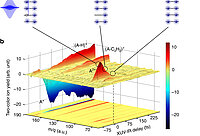
Energy exchange in highly ionized nanoparticles  
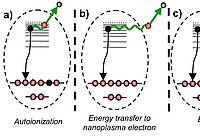
Excited atoms often decay by the emission of radiation, a process known as fluorescence. Another scenario can occur when an excited atom is surrounded by other excited atoms, ions, and electrons.…  
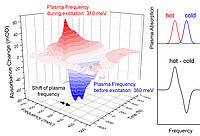
Heat makes you limp: light slows down the vibrations of an electron plasma  
The oscillation frequency of an optically heated electron plasma depends sensitively on the plasma temperature. Ultra-fast heating and cooling of a plasma in the semiconductor zinc oxide (ZnO) leads…  
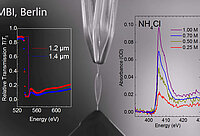
Ultrathin water films made to flow - A flat ray for X-ray spectroscopy  
An important advance in the spectroscopy of soft X-ray liquid samples by a new flat-beam system paves the way for novel stationary and time-resolved experiments.  
On the trail of the mystery of organic matter in space  
For several years, there has been strong evidence that huge amounts of complex organic compounds have already formed in the interstellar clouds in the early days of the universe. This is suggested by…  
European Network of Laser Research Institutes successful in Horizon 2020  
LASERLAB-EUROPE, the network of major European laser research facilities, can successfully look forward to a new phase of cooperation from 2015 to 2019. In one of the first calls for proposals under…  
Investigation of molecular chirality on a sub-femtosecond time scale  
A new nonlinear, all-optical method for detecting chiral molecules has been proposed and demonstrated. It is significantly more sensitive than conventional all-optical methods and also allows a…  
Are monster waves predictable?  
A comparative analysis of monster waves in different physical systems comes to the surprising conclusion that these rare events are by no means always completely unpredictable.  
How long does an electron take to tunnel?  
The combination of ab-initio numerical experiments and theory shows that the optical tunneling of an electron from an atom can take place instantaneously.  
Rubicon Research Grant for Geert Reitsma  
The Netherlands Organization for Scientific Research (NWO) honors the scientist Geert Reitsma with the renowned Rubicon Grant for his research project "Recording biomolecules in action" (Original:…