Ocean rogue waves: a mystery unveiled?

Rogue waves are extremely high ocean waves that exceed the significant wave height by more than a factor of 2. Extreme waves are also very rare; less than one in 100,000 waves exceeds the rogue wave criterion. While their existence was long disputed throughout the 1990s, thousands of rogue waves have been recorded on oil rigs in the past 20 years. Nevertheless, the origin of rogue waves is still disputed, with a multitude of competing theories that fall into two basic categories: linear theories consider incidental random interference the origin of rogue waves. This means that it is just bad luck when your ship is hit by a rogue wave. Then nothing can be done to foresee such an event. Recently nonlinear theories gained increasing popularity as they promise that certain characteristic wave patterns may possibly precede a rogue event. While this appears very appealing, neither theory can sufficiently explain the measured probabilities of rogue waves in the ocean.

In a collaborative effort, the group of Günter Steinmeyer at the Max-Born-Institut in Berlin together with colleagues from the Leibniz-University in Hannover and the Technical University in Dortmund now report a new approach to shed more light on the rogue wave mystery. To this end, they suggest a new metric for the complexity of the wave motion, namely, the so-called phase space dimension. This metric measures the effective number of waves that interfere at one given location on the ocean surface. More importantly, they also propose a way to measure the dimension, and this measurement could readily be implemented on ships, possibly providing an early warning of rogue waves.

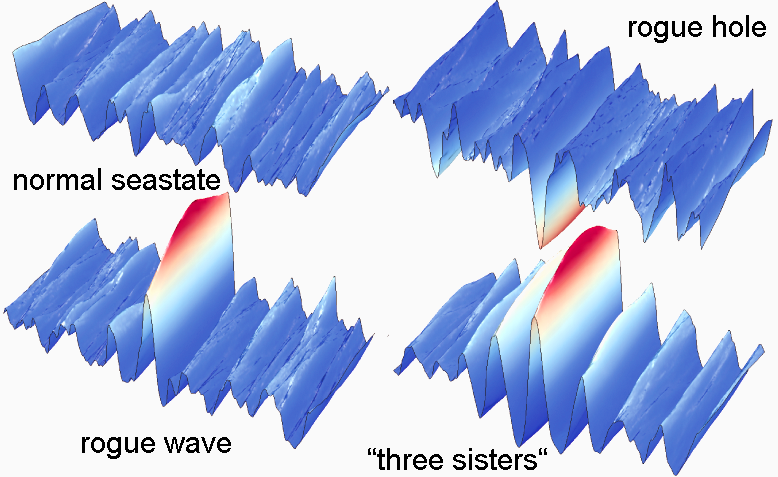
Fig. 1: Numerical simulations of prototypical rogue waves in the ocean. Top left: Normal sea state. Top right: Rogue hole. Bottom left: Rogue wave. Bottom right: Rogue wave group, also known as "three sisters". Ocean nonlinearities are only required to explain why rogue holes are even more rare than positive rogue waves. Whether rogue waves appear isolated or in a group depends on the spectral width of the sea state.

In fact, it seems that the capability of the ocean to form rogue waves is variable. The study suggests that the ocean surface movement is fairly simply structured throughout most of the time. Even in heavy storms, mostly conditions prevail that do not enable rogue wave formation. However, the complexity of the wave patterns may suddenly increase when crossing seas are generated, resulting in rogue-wave prone situations. Using the suggested dimensional analysis, it is exactly these rogue-wave prone situations that can be detected. Nevertheless, the individual rogue wave event remains unforeseeable. Moreover the study suggests that the ocean dynamics are ruled by linear yet still very complex dynamics.
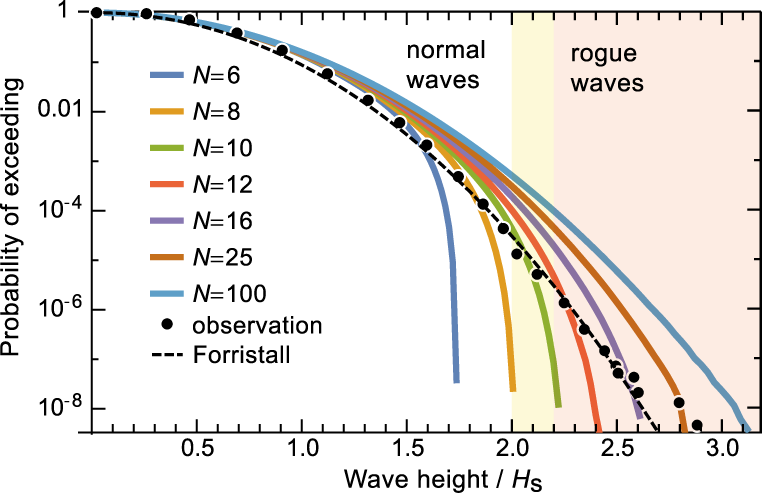
Fig 2: Probability of exceeding the significant wave height by a given factor. Shown are model calculations for a varying number of effectively interfering waves. If this number is smaller than 10, then no rogue waves can appear. The danger of rogue wave emergence increases when more and more waves are interacting with each other. If waves from different locations propagate towards the same location in the ocean, then the risk for rogue waves becomes extreme. Also shown for comparison are results of longterm averaged observations as well as the empirical Forristall distribution.

The study therefore opens a new perspective for a better understanding of ocean rogue waves. Much research went into ocean nonlinearities, but it appears that the latter play a minor role for rogue wave formation. In contrast, winds have found very little attention in the rogue wave discussion so far. As winds are ultimately the drivers behind ocean wave formation in general, it therefore seems perfectly possible to identify rogue-wave prone situations from meteorological analysis, identifying situations that may give rise to crossing seas early on. The appearance of an individual rogue wave may remain a mystery, but at least, we may soon be able to predict the "rogueness" of ocean weather hours or days in advance.

Search publications of MBI

advanced search
Search results

Publications since 2025

Sort: Year Author Title Journal
A1-P-2025.01
Melting, bubblelike expansion, and explosion of superheated plasmonic nanoparticles

S. Dold, T. Reichenbach, A. Colombo, J. Jordan, I. Barke, P. Behrens, N. Bernhardt, J. Correa, S. Düsterer, B. Erk, T. Fennel, L. Hecht, A. Heilrath, R. Irsig, N. Iwe, P. Kolb, B. Kruse, B. Langbehn, B. Manschwetus, P. Marienhagen, F. Martinez, K.-H. Meiwes-Broer, K. Oldenburg, C. Passow, C. Peltz, M. Sauppe, F. Seel, R. M. P. Tanyag, R. Treusch, A. Ulmer, S. Walz, M. Moseler, T. Möller, D. Rupp, B. v. Issendorff

Physical review letters 134 (2025) 136101/1-7

URL, DOI or PDF

A1-P-2025.02
Extreme ultraviolet high-harmonic interferometry of excitation-induced bandgap dynamics in solids

L.-M. Koll, S. V. B. Jensen, P. J. van Essen, B. de Keijzer, E. Olsson, J. Cottom, T. Witting, A. Husakou, M. J. J. Vrakking, L. B. Madsen, P. M. Kraus, P. Jürgens

Optica 12 (2025) 1606-1614

URL, DOI or PDF

A1-P-2025.03
Visualizing the three-dimensional arrangement of hydrogen atoms in organic molecules by Coulomb explosion imaging

A. E. Green, K. Chen, S. Bhattacharyya, F. Allum, S. Usenko, M. N. R. Ashfold, T. M. Baumann, K. D. Borne, M. Brouard, M. Burt, B. F. E. Curchod, B. Erk, R. J. G. Forbes, L. M. Ibele, R. A. Ingle, H. V. Sa Lam, X. Li, K. Lin, T. Mazza, J. W. McManus, M. Meyer, T. Mullins, J. P. Figueira Nunes, D. Rivas, A. Roerig, A. Rouzee, P. Schmidt, J. Searles, B. Senfftleben, H. Stapelfeldt, R. M. P. Tanyag, F. Tranter, A. S. Venkatachalam, E. Wang, E. M. Warne, P. M. Weber, T. J. A. Wolf, T. Jahnke, A. Rudenko, R. Boll, D. Rolles

Journal of the American Chemical Society 147 (2025) 1-17

A2-P-2025.03
Attosecond optical orientation

L. B. Drescher, N. Mayer, K. Gannan, J. R. Adelman, S. R. Leone

Physical Review Letters 135 (2025) 163201/1-8

URL, DOI or PDF

A2-P-2025.04
Dynamic enhancement of single-shot temporal contrast measurement by self-referenced spectral interferometry

S. Bock, T. Oksenhendler, T. Witting, R. Gebhardt, U. Helbig, A. Dotsenko, Y.-Y. Chang, J. Dreyer, T. Toncian, U. Schramm

Optics Express 33 (2025) 42402-42407

URL, DOI or PDF

A3-P-2025.01
Second-harmonic generation in OP-GaAs0.75P0.25 heteroepitaxially grown from the vapor phase

L. Wang, S. R. Vangala, S. Popien, M. Beutler, J. M. Mann, V. L. Tassev, E. Büttner, V. Petrov

CrystEngComm 27 (2025) 1373-1376

URL, DOI or PDF

A3-P-2025.02
Diode-pumped Kerr-lens mode-locked Yb:MgWO4 laser

H.-Y. Nie, Z.-L. Lin, P. Loiko, H.-J. Zeng, L. Zhang, Z. Lin, G. Z. Elabedine, X. Mateos, V. Petrov, G. Zhang, W. Chen

Optics Letters 50 (2025) 1049-1052

URL, DOI or PDF

A3-P-2025.03
Growth, anisotropy, and spectroscopy of Tm3+ and Yb3+ doped MgWO4 crystals

G. Z. Elabedine, R. M. Solé, S. Slimi, M. Aguiló, F. Díaz, W. Chen, V. Petrov, X. Mateos

CrystEngComm 27 (2025) 1619-1631

URL, DOI or PDF

A3-P-2025.04
Growth, structure, spectroscopic, and laser properties of Ho-doped yttrium gallium garnet crystal

S. Slimi, H. Yu, H. Zhang, C. Kränkel, P. Loiko, R. M. Solé, M. Aguiló, F. Díaz, W. Chen, U. Griebner, V. Petrov, X. Mateos

Optics Express 33 (2025) 2529-2541

URL, DOI or PDF

A3-P-2025.05
Growth, spectroscopy and laser operation of disordered Tm,Ho:NaGd (MoO4)2 crystal

G. Z. Elabedine, Z. Pan, P. Loiko, H. Chu, D. Li, K. Eremeev, K. Subbotin, S. Pavlov, P. Camy, A. Braud, S. Slimi, R. M. Solé, M. Aguiló, F. Díaz, W. Chen, U. Griebner, V. Petrov, X. Mateos

Journal of Alloys and Compounds 1020 (2025) 179211/1-12

URL, DOI or PDF

A3-P-2025.06
Kerr-lens mode-locked, diode-pumped Yb,Gd:YAP laser generating 23 fs pulses

H.-Y. Nie, P. Zhang, P. Loiko, Z.-L. Lin, H.-J. Zeng, G. Zhang, Z. Li, X. Mateos, H.-C. Liang, V. Petrov, Z. Chen, W. Chen

Optics Express 33 (2025) 11793-11799

URL, DOI or PDF

A3-P-2025.07
Nanoindentation and laser-induced optical damage tests of CdSe nonlinear crystals

G. Exner, A. Carpenter, K. Cissner, A. Hildenbrand-Dhollande, S. Schmitt, A. Grigorov, M. Piotrowski, S. Guha, V. Petrov

Journal of the Optical Society of America B 42 (2025) A10-A14

URL, DOI or PDF

A3-P-2025.08
Phase-matching properties of AgGa(Se1-xTex)2 for SHG of a CO2 laser

K. Kato, V. Petrov, K. Miyata

Proceedings of SPIE 13347 (2025) 133470S/1-4

URL, DOI or PDF

A3-P-2025.09
Phase-matching properties of ZnSiAs2 in the mid-IR

T. Okamoto, N. Umemura, K. Kato, V. Petrov

Proceedings of SPIE 13347 (2025) 133470C/1-5

URL, DOI or PDF

A3-P-2025.10
Direct generation of 3.5 optical-cycle pulses from a rare-earth laser

N. Zhang, Y. Wang, H. Ding, F. Liang, Y. Zhao, J. Xu, H. Yu, H. Zhang, V. Petrov

Optics Letters 50 (2025) 3150-3153

URL, DOI or PDF

A3-P-2025.11
Power scaling of a non-resonant optical parametric oscillator based on periodically poled LiNbO3 with spectral narrowing

S. Das, T. Temel, G. Spindler, A. Schirrmacher, I. B. Divliansky, R. T. Murray, M. Piotrowski, L. Wang, W. Chen, O. Mhibik, V. Petrov

Optics Express 33 (2025) 5662-5669

URL, DOI or PDF

A3-P-2025.12
Sub-40-fs diode-pumped ytterbium-doped mixed rare-earth calcium oxoborate laser

H.-J. Zeng, Z.-L. Lin, H. Lin, P. Loiko, L. Zhang, Z. Lin, H.-C. Liang, X. Mateos, V. Petrov, G. Zhang, W. Chen

Optics Express 33 (2025) 17965-17975

URL, DOI or PDF

A3-P-2025.13
Spectroscopy and SESAM mode-locking of a disordered Yb:Gd2SrAl2O7 crystal

H.-J. Zeng, Z.-L. Lin, P. Loiko, F. Yuan, G. Zhang, Z. Lin, X. Mateos, V. Petrov, W. Chen

Optics Express 33 (2025) 15057-15066

URL, DOI or PDF

A3-P-2025.14
Watt-level, 1.6 ps χ(2)-lens mode-locking of an in-band pumped Nd:LuVO4 laser

H. Iliev, V. Aleksandrov, V. Petrov, L. S. Petrov, H. Zhang, H. Yu, I. Buchvarov

Optics Express 33 (2025) 17773-17781

URL, DOI or PDF

A3-P-2025.15
Refined phase-matching predictions for AgGa1-xInxS2 mixed chalcopyrite crystals

K. Kato, K. Miyata, V. Petrov

Journal of the Optical Society of America B 42 (2025) A6-A9

URL, DOI or PDF