A dropped fridge magnet offers a simple glimpse into a complex physical phenomenon: although it appears undamaged on the outside, its holding force can weaken because its internal magnetic structure has reorganized into countless tiny regions with opposing magnetization, so-called magnetic domains. These nanoscale textures are central to modern magnetism research, but observing them at very short time scales has long required access to large-scale X-ray free-electron laser (XFEL) facilities.
Researchers at the Max Born Institute (MBI) have now developed a laboratory-scale soft-X-ray instrument capable of seeing these hidden structures with nanometer (10-9 m) spatial and picosecond (10-12 s) temporal resolution. Their work, published in Light: Science & Applications, shows that the ultrafast dynamics of magnetic domains can be tracked in great detail directly in the lab.
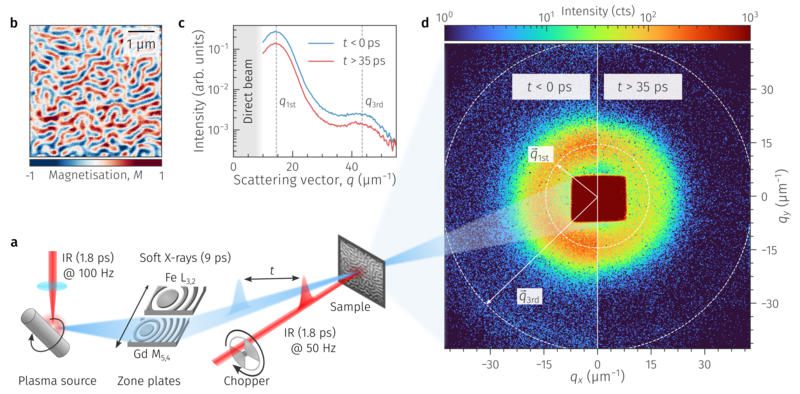
Soft X-rays combine exceptional sensitivity to magnetic order with element specificity and high spatial resolution. In a small-angle X-ray scattering (SAXS) geometry, real-space magnetic domain patterns are translated into intensity distributions in reciprocal space, see Fig. 1d, providing rich information about the long- and short-range order of complex magnetic textures.