Monster waves in the optical experiment - the storm in the test tube

Random events in nature are often subject to a so-called normal distribution, which allows predicting the probability of extreme events reliably. Especially in meteorology, there are a number of processes in which extremely strong and destructive events occur more frequently than can be predicted from many years of observation of weaker events. Examples include unexpectedly strong storms or other extreme weather events, another the occurrence of so-called monster waves in the sea.

5 years ago qualitatively similar behavior was observed in the propagation of intense light pulses through a glass fiber, ie in a completely different physical system. Since the observation of extreme momentum energies in this system requires relatively little effort, this observation has initiated its own research area on "optical monster waves". In a work published by Physical Review Letters, researchers at the Max Born Institute present a new optical system in which monster waves occur. Unlike in all previous works, this phenomenon is caused by atmospheric turbulence in a gas cell, ie a kind of storm in the test tube and thus by a microscopic meteorological phenomenon. If a bundle of high-intensity parallel light beams (so-called filaments) is generated in such a cell, the turbulence can lead to the brief fusion of individual beams, which generates light flashes observable to the naked eye. A detailed analysis of the experimental data shows that the statistical distribution of these flashes of light is much more extreme than that of meteorological events. Sea waves are already considered monster waves when they exceed the significant wave height by a factor of two. In the optical system, on the other hand, even light flashes occur that exceed the characteristic intensity by a factor of 10, ie really rough optical weather.
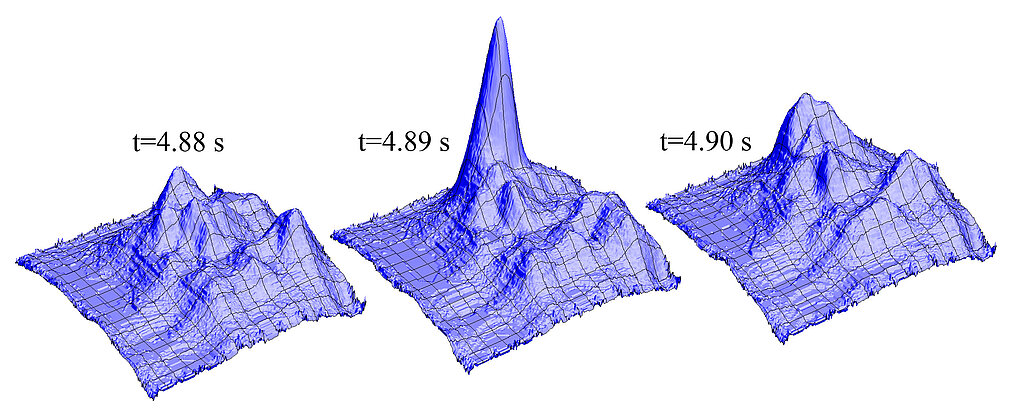
Fig. 1 Successive snapshots of a measured optical monster wave. The intensity is shown as wave height. The event is spatially and temporally isolated. The wave emerges within a hundredth of a second without notice and disappears just as quickly.

Search publications of MBI

advanced search
Search results

Publications since 2026

Sort: Year Author Title Journal
A1-P-2026.01
Fragmentation dynamics of CS2 dications and trications following S 2p ionization

F. Allum, C.-S. Lam, B. Erk, H. Bromberger, P. H. Bucksbaum, M. Britton, M. Burt, N. Ekanayake, I. Gabalski, D. Garg, E. Gougoula, D. Heathcote, A. J. Howard, P. Hockett, D. M. P. Holland, S. Kumar, J. W. L. Lee, J. McManus, J. Mikosch, D. Milešević, R. S. Minns, C. C. Papadopoulou, C. Passow, W. O. Razmus, A. Röder, D. Rolles, A. Rouzée, M. S. Schuurman, A. Simao, A. Stolow, A.-T. Noor, J. Unwin, C. Vallance, T. Walmsley, M. Brouard, R. Forbes

Journal of Chemical Physics 164 (2026) 024304/1-16

URL, DOI or PDF

A3-P-2025.28
Few-cycle pulses with 40 W average power at 100 kHz from a flat-top pumped OPCPA

H. Kassab, V. Fortin, M. Lavastre, L. Oppermann, G. Arisholm, T. Witting, M. J. J. Vrakking, S. Petit, F. J. Furch

Optics Express 34 (2026)

URL, DOI or PDF

A3-P-2026.01
Apparatus for broadband, time-resolved measurements of laser-induced reflectivity transients with sub-10 fs resolution

H. M. Wrigge, T. Held, P. D. Ndione, T. Nagy, B. Rethfeld, P. Simon

Optics & Laser Technology 193, Part B (2026) 114354/1-8

URL, DOI or PDF

B1-P-2025.18
Soft X-ray imaging with coherence tomography in the water window spectral range using highharmonic generation

J. Reinhard, F. Wiesner, M. Hennecke, T. Sidiropoulos, S. Kaleta, J. Späthe, J. J. Abel, M. Wünsche, G. Schmidl, J. Plentz, U. Hübner, K. Freiberg, J. Apell, S. Lippmann, M. Schnürer, S. Eisebitt, G. G. Paulus, S. Fuchs

Light: Science & Applications 15 (2026) 79/1-10

URL, DOI or PDF

B4-P-2026.01
Studies on multiferroics with weak magnetoelectric coupling using Green's function method

P. Balasubramanian, M. Sharma, T. Nishanth, K. Vikram

Physical Review B 724 (2026) 418166/1-7

URL, DOI or PDF

C1-P-2025.03
Transient electronic polarizability of β-carotene from ultrafast terahertz Stark spectroscopy J. Zhang, C. Jaschke, B. P. Fingerhut, T. Elsaesser Journal of Physical Chemistry Letters Online (2026)

URL, DOI or PDF

C3-P-2025.04
Light wave induced nanosecond-long persistent state in the Dirac semimetal Cd3As2

A. Ghalgaoui, P. Pilch, T. Kang, M. Runge, S. Kovalev, Y. Yang, F. Xiu, Z. Wang

Physical Review B 113 (2026) L041106/1-7

URL, DOI or PDF

T1-P-2026.01
Keldysh approach to calculating the ionization rate in strong two-color fields

V. Tamulienė, I. Babushkin

Physical Review A 113 (2026) 013512/1-24

URL, DOI or PDF

T1-P-2026.02
Encoding and manipulating ultrafast coherent valleytronic information with lightwaves

F. Gucci, E. B. Molinero, M. Russo, P. San-Jose, F. V. A. Camargo, M. Maiuri, M. Y. Ivanov, Á. Jiménez-Galán, R. E. F. Silva, S. Dal Conte, G. Cerullo

Nature Photonics online (2026) 1-10

URL, DOI or PDF

T2-P-2026.01
Geometry of chiral temporal structures. I. Physical effects

A. F. Ordonez, A. Roos, P. M. Maier, P. Decleva, D. Ayuso, O. Smirnova

Physical Review A 113 (2026) 013110/1-

URL, DOI or PDF

T2-P-2026.02
Geometry of chiral temporal structures. II. The formalism A. Roos, P. M. Maier, A. F. Ordonez, O. Smirnova Physical Review A 113 (2026) 013111/1-8

URL, DOI or PDF