The basic idea for the diffraction or deflection of atomic particles in a standing light wave was already formulated in 1933 by the physicists Kapitza and Dirac in a theoretical work for electrons. Since electrons interact only weakly with a standing wave, intensive laser radiation was required to experimentally observe the Kapitza-Dirac effect about 15 years ago. On the other hand, light intensities are already sufficient for the diffraction and deflection of atoms, since the strength of the process is enhanced by resonantly increasing the interaction or the use of ultracold, slow atoms. The process is of immense importance in atomic and quantum optics.
Acceleration of atoms in an intensive standing light wave
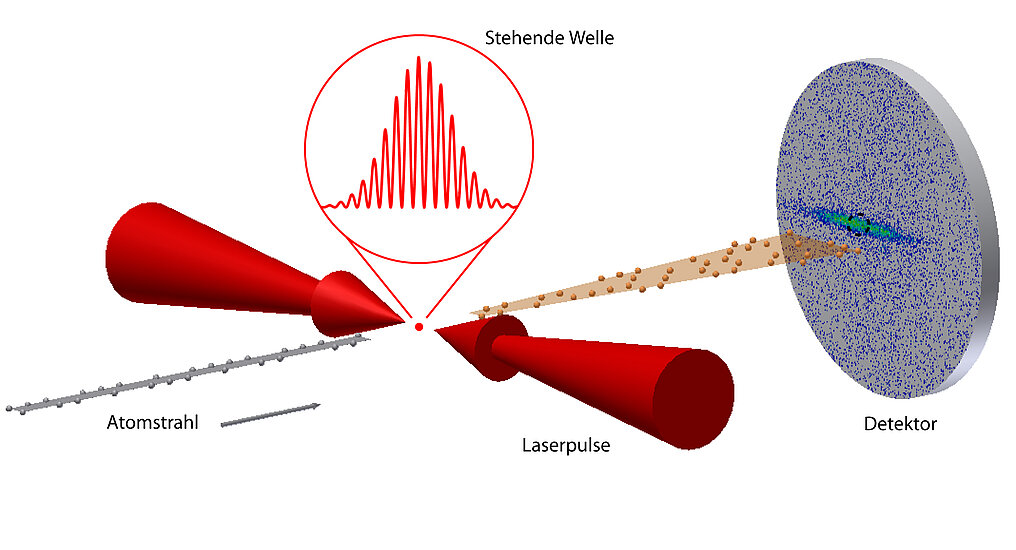
Fig. 1 Sketched is the apparatus construction. A collimated thermal beam of helium atoms is exposed to a standing light field generated by interference of two counter-rotating laser pulses for approximately 40 fs over a space of ~20 μm. The deflection of the atom beam is measured with a location-sensitive detector, measuring the location of each deflected helium atom. Without the forces of the standing wave, the detector signal would only consist of a small spot in the middle, generated by undeflected helium atoms (dashed circle). In fact, however, a broad distribution is measured, as can be seen on the detector image. How can you imagine the forces acting on the atom? Atoms in an ongoing field of light, in which the electromagnetic fields periodically build up in place and in time, experience no accelerating forces. This is similar to a floating object on a water surface that is periodically moved up and down by a wave but does not substantially change its horizontal position. On the other hand, if one freezes wave peaks and valleys at short notice, just as the electromagnetic fields in the standing wave are stationary for a short time, then one can easily imagine that the object slips down in the direction of the wave trough. It is accelerated in this case by gravity, which is replaced in the atomic case by the ponderomotive force.
In the journal Physical Review Letters in the issue of March 21, 2014, S. Eilzer, H. Zimmermann and U. Eichmann published a paper in which they deflected atoms in an intense standing light wave for the first time, using two opposing short laser pulses Now, the Kapitza-Dirac effect for atoms has now been demonstrated in a range of laser intensities where atoms are dominated by both the dominant field strength and the extreme intensity gradient ionize high probability, ie, that an electron is released from the atomic network. The fact that this does not necessarily always happen and instead the entire undamaged atom is accelerated, is due to the recently researched at the MBI process of suppressed tunnel ionization, in which the electron oscillates during the laser pulse at a great distance from the atomic core, but ultimately not enough energy from the Laser field picks up to free themselves from the clutches of the attractive nuclear hull. During this time, the electron senses the so-called ponderomotive force, which is caused by its quasi-free periodic movement in the intensity gradient. Since the electron eventually remains bound, this force acting along the laser beam axis is transmitted to the entire atom and leads to its deflection. In continuation of earlier experiments that investigated atomic acceleration in a strong focused light field, the intensity gradient in the standing light wave is now significant over atomic dimensions and therefore also influences the atomic dynamics, see Figure 2. The theoretical description of both the electron dynamics and the Atomic center-of-gravity motion in a standing wave poses a major challenge to current strong-field theory. In further experiments the influence of the strong intensity gradient on the atomic dynamics will be investigated.

Fig. 2 The red and blue curves show velocity distributions determined from the measured deflections for standing waves generated from two elliptically polarized counter-rotating laser pulses with ellipticity ∈ = 0.85 and 0.6, respectively. In the first case, investigations on the dependence on the laser intensity have shown that the deflection of the atoms is limited by ionizing above a certain intensity gradient. Due to the changed polarization, however, in the second case, atoms can be deflected almost twice as much without ionizing them. This is obviously because dynamic processes prevent ionization. Although a qualitative understanding has been achieved, see the black curve adapted to the data, a quantitative confirmation of nonionization with simultaneous acceleration in the context of a quantum mechanical strong field theory is still pending.
Search publications of MBI
Publications since 2025
A1-P-2025.01
Melting, bubblelike expansion, and explosion of superheated plasmonic nanoparticles
Physical review letters
134
(2025) 136101/1-7
A1-P-2025.02
Extreme ultraviolet high-harmonic interferometry of excitation-induced bandgap dynamics in solids
Optica
12
(2025) 1606-1614
A1-P-2025.03
Visualizing the three-dimensional arrangement of hydrogen atoms in organic molecules by Coulomb explosion imaging
Journal of the American Chemical Society
147
(2025) 1-17
A2-P-2025.03
A2-P-2025.04
Dynamic enhancement of single-shot temporal contrast measurement by self-referenced spectral interferometry
Optics Express
33
(2025) 42402-42407
A3-P-2025.01
Second-harmonic generation in OP-GaAs0.75P0.25 heteroepitaxially grown from the vapor phase
CrystEngComm
27
(2025) 1373-1376
A3-P-2025.02
Diode-pumped Kerr-lens mode-locked Yb:MgWO4 laser
Optics Letters
50
(2025) 1049-1052
A3-P-2025.03
Growth, anisotropy, and spectroscopy of Tm3+ and Yb3+ doped MgWO4 crystals
CrystEngComm
27
(2025) 1619-1631
A3-P-2025.04
Growth, structure, spectroscopic, and laser properties of Ho-doped yttrium gallium garnet crystal
Optics Express
33
(2025) 2529-2541
A3-P-2025.05
Growth, spectroscopy and laser operation of disordered Tm,Ho:NaGd (MoO4)2 crystal
Journal of Alloys and Compounds
1020
(2025) 179211/1-12
A3-P-2025.06
Kerr-lens mode-locked, diode-pumped Yb,Gd:YAP laser generating 23 fs pulses
Optics Express
33
(2025) 11793-11799
A3-P-2025.07
Nanoindentation and laser-induced optical damage tests of CdSe nonlinear crystals
Journal of the Optical Society of America B
42
(2025) A10-A14
A3-P-2025.08
Phase-matching properties of AgGa(Se1-xTex)2 for SHG of a CO2 laser
Proceedings of SPIE
13347
(2025) 133470S/1-4
A3-P-2025.09
Phase-matching properties of ZnSiAs2 in the mid-IR
Proceedings of SPIE
13347
(2025) 133470C/1-5
A3-P-2025.10
Direct generation of 3.5 optical-cycle pulses from a
rare-earth laser
Optics Letters
50
(2025) 3150-3153
A3-P-2025.11
Power scaling of a non-resonant optical parametric oscillator based on periodically poled LiNbO3 with spectral narrowing
Optics Express
33
(2025) 5662-5669
A3-P-2025.12
Sub-40-fs diode-pumped ytterbium-doped mixed rare-earth calcium oxoborate laser
Optics Express
33
(2025) 17965-17975
A3-P-2025.13
Spectroscopy and SESAM mode-locking of a disordered Yb:Gd2SrAl2O7 crystal
Optics Express
33
(2025) 15057-15066
A3-P-2025.14
Watt-level, 1.6 ps χ(2)-lens mode-locking of an in-band pumped Nd:LuVO4 laser
Optics Express
33
(2025) 17773-17781
A3-P-2025.15
Refined phase-matching predictions for AgGa1-xInxS2 mixed chalcopyrite crystals
Journal of the Optical Society of America B
42
(2025) A6-A9