4.3 Nanoscale Samples and Integrated Optics
Project coordinators: A. Mermillod-Blondin , D. EngelT3: Fs-laser microprocessing
Ultrashort pulses offer the unique possibility to induce permanent structural modifications inside the bulk of transparent materials. In tight focusing conditions (numerical aperture > 0.4), the spatial confinement of the laser pulse provides ideal irradiation conditions (in terms of focal size and local intensity) to directly photoinscribe optical microcircuits able to perform complex tasks.
Plasma diagnostics
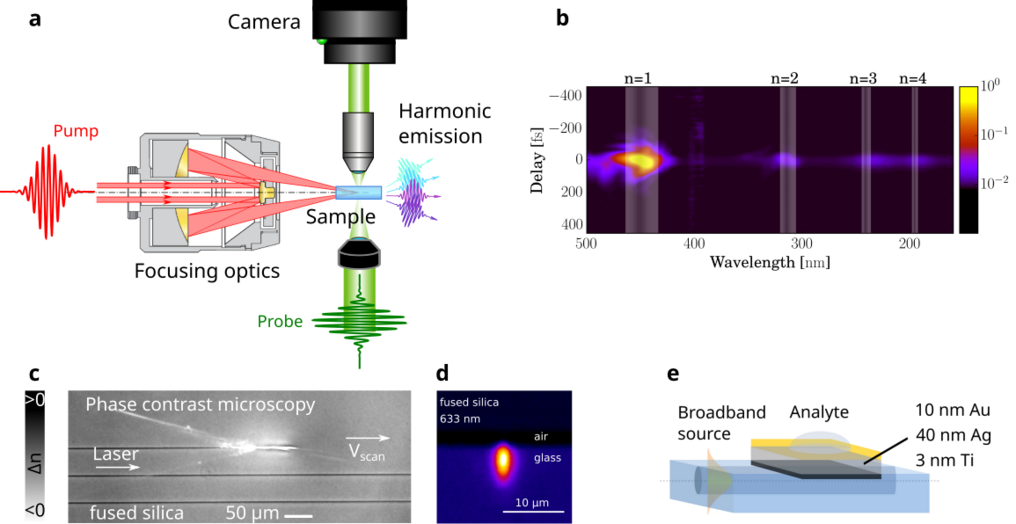
In order to advance the field of fs-laser microprocessing, a fundamental understanding of the plasma formation and relaxation is sorely needed. In solids, the plasma formation happens intrapulse, which greatly complicates all diagnostics based on traditional pump-probe observations. At MBI, an original technique based on the emission of low-order harmonics is currently under constant improvement to obtain fundamental information on the plasma buildup.
The energy contained in the plasma eventually relaxes and fuels permanent structural modifications leading to the functionalization of the substrate. The energy relaxation happens after the laser pulse, which allows to use conventional optical methods (e.g. phase-contrast microscopy, coherent diffractive imaging, or direct shadowgraphy) arranged in a pump-probe scheme.
Direct laser writing of optical chips
Fs laser photoinscription is a powerful and versatile tool to manufacture complex optical microsystems. These microsystems may consist in a judicious arrangement of bulk and surface waveguides, cascaded microinterferometers, Bragg resonators, polarization sensitive elements and microchannels. Such a diversity offers a remarkable potential for applications including (bio-)sensing, plasmonics, nonlinear optics on a chip, or ultraprecise interferometry.
At MBI, a peculiar emphasis is put on the unique properties of few-cycle pulses (with a duration < 10 fs) to expand the capabilities of direct laser photoinscription. As an example, few-cycle pulses have been used to inscribe surface waveguides on a fused silica substrate with applications in the field of direct refractive index and plasmonic sensing.