Search results 251 until 260 of 5664
White turns into (extreme-)ultraviolet  
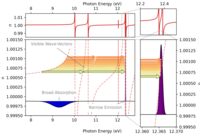
Researchers from the Max Born Institute for Nonlinear Optics and Short Pulse Spectroscopy (MBI) have developed a new method to modify the spectral width of extreme-ultraviolet (XUV) light. By…  
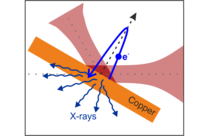
High-flux table-top source for femtosecond hard X-ray pulses  
Femtosecond hard X-ray pulses are an important tool for unraveling structure changes of condensed matter on atomic length and time scales. A novel laser-driven X-ray source provides femtosecond…  
Extending solid-state electronic structure calculations to ultra long-range length scales  
Density functional theory (DFT) has had a tremendous impact on solid-state physics and is, due to its computational efficiency, at the heart of modern computer based material research. While DFT…  
Chemistry in Motion - Jochen Mikosch receives 2 million Euro of funding from the European Research Council (ERC)  
Jochen Mikosch receives a prestigious Consolidator Grant from the European Research Council (ERC). In a highly competitive and thorough procedure it is awarded to established researchers with 7-12…  
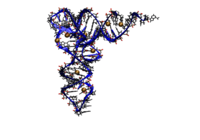
Magnesium contact ions stabilize the macromolecular structure of transfer RNA  
In cells transfer RNA (tRNA) translates genetic information from the encoding messenger RNA (mRNA) for protein synthesis. New results from ultrafast spectroscopy and in-depth theoretical calculations…  
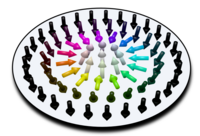
Twisting magnetization with light – Laser pulses enable faster creation of skyrmions in magnets  
A team of scientists led by the Max Born Institute (MBI), Berlin, Germany, and the Massachusetts Institute of Technology (MIT), Cambridge, USA, has demonstrated how tiny magnetization patterns known…  
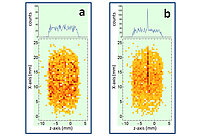
Photon-recoil imaging: a new route to study nonlinear x-ray physics  
One key scientific driver for the development of intense x-ray free-electron lasers (XFELs) has been the prospect to transfer the concepts of nonlinear optics into the x-ray spectral range. Now…  
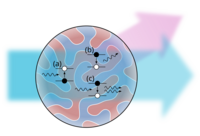
Who stole the light? Self-induced ultrafast demagnetization limits the amount of light diffracted from magnetic samples at soft x-ray energies  
Free electron X-ray lasers deliver intense ultrashort pulses of x-rays, which can be used to image nanometer-scale objects in a single shot. When the x-ray wavelength is tuned to an electronic…  
Self-imaging of a molecule by its own electrons: mapping the atomic motion during a molecular vibration  
One of the long-standing goals of research on the light-induced dynamics of molecules is to observe time-dependent changes in the structure of molecules, which result from the absorption of light, as…