4.3 Nanoscale Samples and Integrated Optics
Project coordinators: A. Mermillod-Blondin , D. EngelTOPIC 1: Optical elements for XUV and soft x-rays

We develop and produce nano- and microscale optical elements and substrates for single- and multiple-shot experiments that are optimized for FEL and HHG sources. As well, one aspect is the optimization of plasmonic structures for subwavelength confinement of optical excitation in order to achieve control of magnetism in the nanoscale. To enhance sensitivity and specificity in these studies, we place strong emphasis on the customized nanoscale structuring of in-house fabricated samples. This approach allows the integration of advanced spectroscopy, scattering, and imaging techniques for deeper physical insight. Strategies such as incorporating optical near-field structures or back-thinning single crystals for XUV transparency have significantly increased the accessible information content.
Example 1: Soft-x-ray-transparent single-crystalline substrates
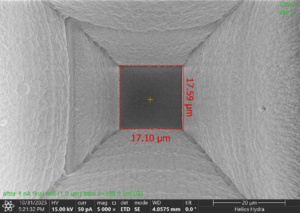
We developed a new method to perform soft-x-ray transmission experiments on:
- single-crystalline ferroelectric and multiferroic thin films;
- low-damping magnonic materials such as YIG.
We prepare transparent windows of several 10 μm size and sub-micrometer thickness with a combination of mechanical grinding and polishing, and focused ion beam (FIB) milling. Depending on the experiment, these windows may then be further processed into FTH samples.
Example 2: Fourier transform holography (FTH) masks

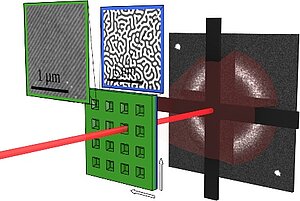
FTH is a mask-based, coherent diffractive imaging technique that allows for efficient, high-resolution (<5 nm) imaging.
- Simultaneously compatible with high magnetic fields (~1 T), cryogenic temperatures, optical laser excitation and GHz current pulse injection.
- We routinely prepare FTH mask for experiments at PETRA III and MAX IV in various geometries and on a broad range of substrate materials.
Example 3: X-ray optics for FEL beamlines
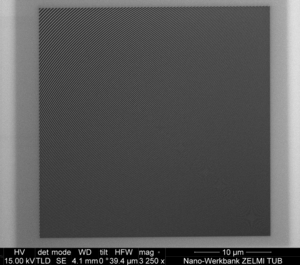
Off-center segments of hyperbolic zone plates in Ta-films on Si3N4 membranes. These specially designed x-ray optics facilitate direct disturbance-free, in-situ measurements of the local intensity distribution in focused x-ray beams from free-electron laser facilities.
Example 4: Forked grating order-sorting apertures
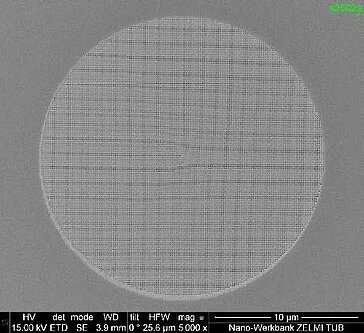
Sub-30 nm apertures are used to multiplex the zone-plate focus of a scanning transmission x-ray microscope (STXM) into 13×13 sub-foci.
- increases the scanning efficiency in conventional STXM by two orders of magnitude.